I watched a client stare at her hands for ten minutes yesterday.
She had come in asking for coffin nails because that's what her favorite influencer wears. But her fingers are short. Her nail beds are wide. And the coffin shape she wanted would have made her hands look wider, not longer.
We tried almond instead. Same length, same color, different silhouette. She stared at the result like she'd never seen her own hands before. 'They look elegant,' she said. 'Actually elegant.'
That's the thing about almond versus coffin. Most people pick based on what they saw on Instagram. They don't think about what those shapes actually do to their fingers. But nail techs think about it constantly. We see how a shape can make short fingers look longer, wide nail beds look narrower, or a $50 manicure look like it cost $150.
So let's talk about what really separates these two shapes. Not just the visual difference, but how they wear, who they flatter, and which one actually belongs on your hands.
What Almond and Coffin Actually Look Like
People mix these up more than you'd expect.
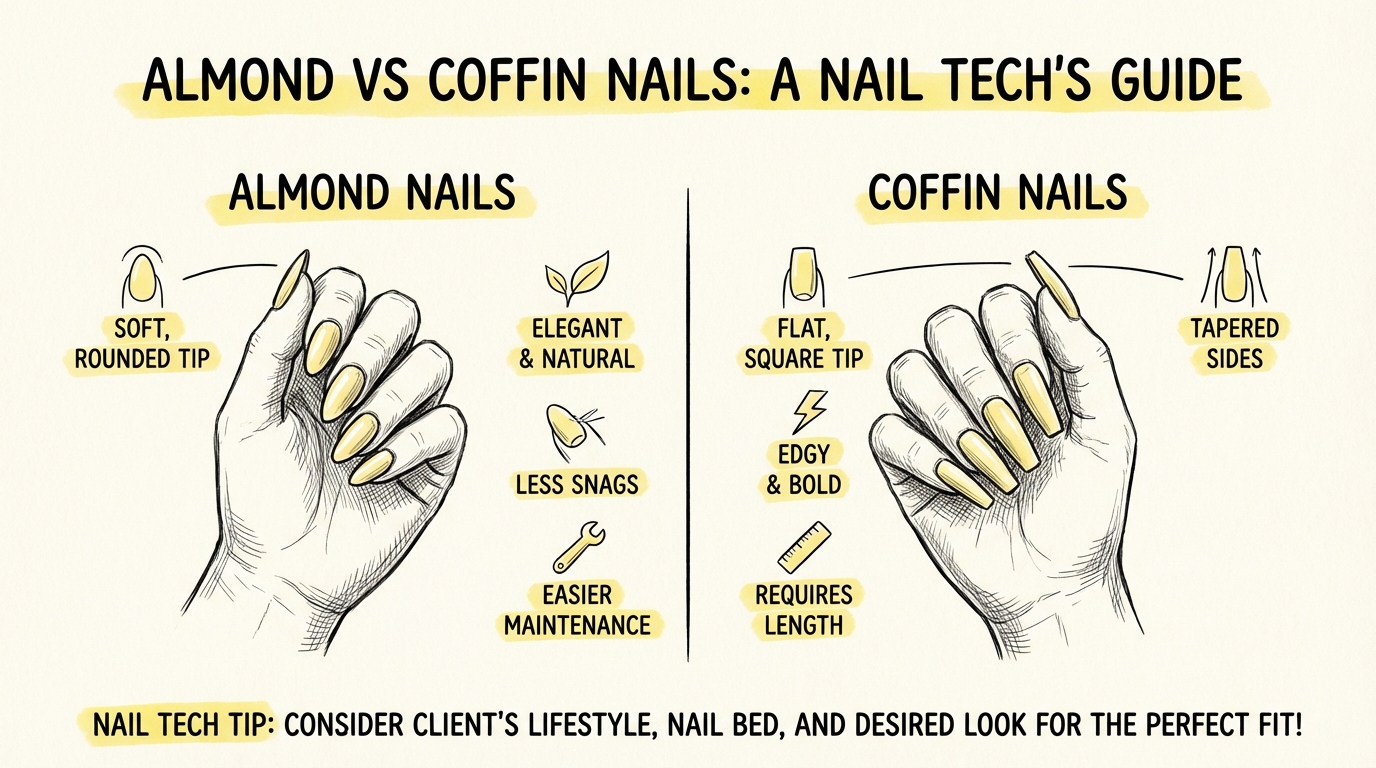
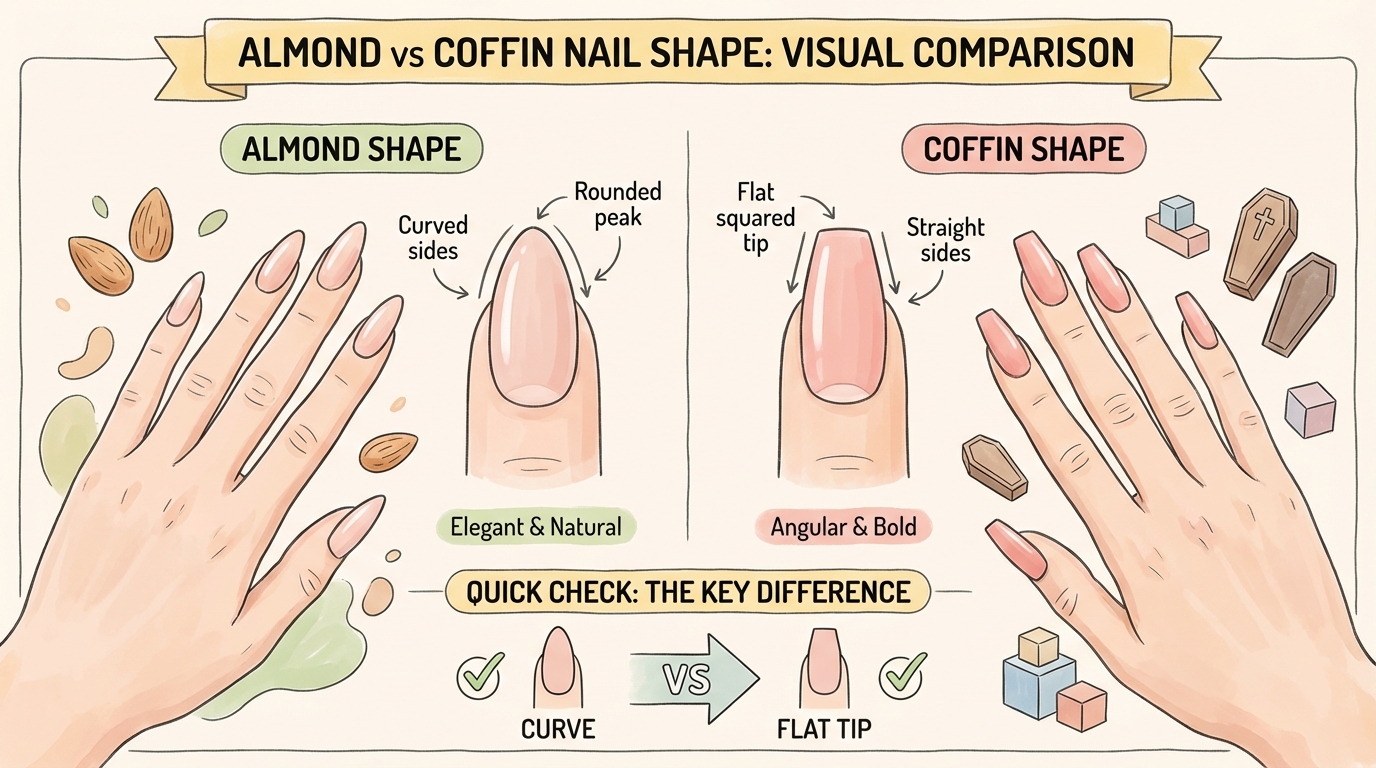
Almond nails taper along the sides to a soft, rounded point. Think of the actual nut. Wide at the base, narrowing gradually to a gentle peak. The sides curve inward smoothly. There are no flat edges, no sharp corners.
Coffin nails (also called ballerina) have straight sides that taper inward, then a flat, squared-off tip. Imagine a coffin. Or a ballerina slipper. The silhouette is angular, architectural, dramatic.
The difference sounds obvious when you read it. But in a salon, under bad lighting, with a nail tech who speaks limited English, you might ask for one and get the other. I've seen it happen. The client wanted almond's softness. She got coffin's drama instead.
Here's a quick check if you're not sure what you're looking at: Does the tip curve or is it flat? Curve means almond. Flat means coffin. That's the giveaway.
How They Change Your Hands
This is where most articles stop describing and start generalizing. They'll tell you almond is 'flattering' and coffin is 'bold' without explaining what that means for your actual hands.
Let me be specific.
Almond elongates. The tapered sides draw the eye lengthwise along your finger. The rounded tip softens the overall silhouette. If you have short fingers, wide nail beds, or hands that photograph stubby, almond fixes that. It's the shape that makes everyone's hands look better in photos. That's why it dominates Instagram.
Coffin widens visually. The straight sides and flat top add horizontal emphasis. On narrow fingers and long nail beds, this creates proportion and balance. On wide fingers and short nail beds, it adds weight where you don't want it.
I had another client last month with naturally slim fingers and narrow nail beds. She'd been getting almond for years because someone told her it was 'the most flattering.' But her hands are already slim. She didn't need elongation. She needed width.
We switched to coffin. Her hands looked stronger, more balanced, more modern. 'I feel like I have adult hands now,' she told me. 'Not dainty little girl hands.'
Neither shape is universally better. They're tools. You pick the one that fixes your specific proportion issue.
The Hand Type Test
Forget what looks good on Instagram models. Look at your own hands.
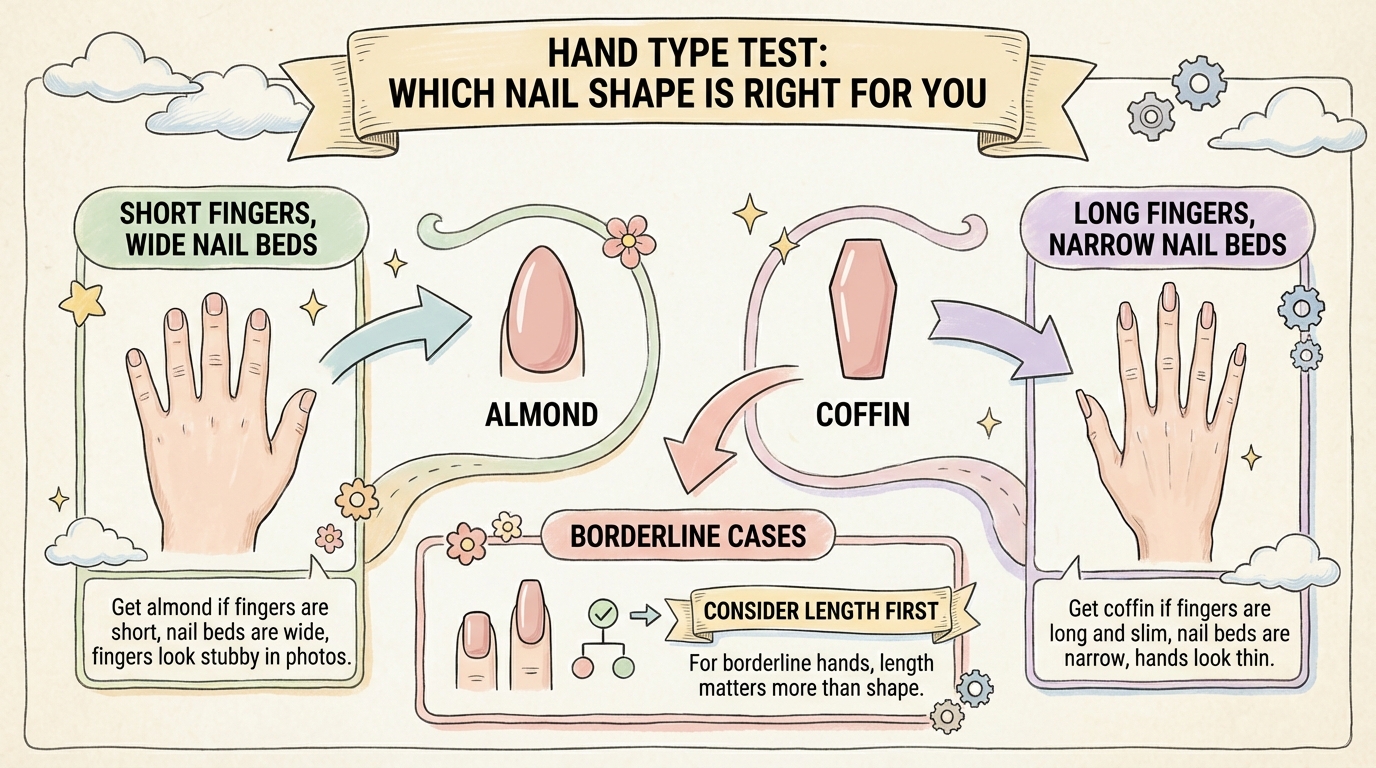
Get almond if: Your fingers are short relative to your palm. Your nail beds are wide. Your fingers look stubby in photos. You want your hands to look more elegant and elongated. You have 'sausage fingers' (her words, not mine).
Get coffin if: Your fingers are long and slim. Your nail beds are naturally narrow. Your hands look thin or bony. You want a stronger, more architectural look. You like that 'baddie' aesthetic.
Either works if: Your fingers are average length with average-width nail beds. You're willing to adjust length to make it work. You care more about the design than the shape itself.
There's a third category too. I call them the 'borderline' hands. Short fingers but narrow nail beds. Long fingers but wide nail beds. For these, length matters more than shape. Short coffin on wide nail beds looks terrible. Long almond on narrow nail beds looks needle-like and strange.
If you're borderline, try medium-length almond first. It's the safer bet. You can always go shorter, longer, or switch to coffin next time.
What Your Lifestyle Actually Requires
Shapes aren't just about looks. They're about what happens when you type, cook, change diapers, or dig through your purse.
Almond is the practical choice. The rounded tip doesn't catch on things. The tapered sides mean less surface area to chip. If you type all day, almond won't click against your keyboard the way coffin's flat tip does. If you have small children, almond won't scratch them.
I've had clients switch to almond specifically for their jobs. Nurses. Physical therapists. People who cook professionally. The shape stays out of the way.
Coffin demands more awareness. That flat tip is a tool. It can open soda cans. It can scratch off stickers. But it also catches on sweater knits, car keys, and hair. The squared corners chip faster than almond's rounded edges. If you work with your hands, coffin requires maintenance discipline.
One client is a rock climber. She loves coffin nails. But she only gets them when she's between climbing trips. The rest of the time, she wears almond. 'Coffin breaks on the wall,' she told me. 'Almond bends.'
That's actually a good way to think about it. Almond bends. Coffin breaks.
The Maintenance Reality
Clients never ask about this until it's too late.
Almond grows out gracefully. The shape stays recognizable even after three weeks. The rounded tip means even growth looks intentional, not ragged. You can stretch an almond manicure to four weeks if you're careful.
Coffin shows growth immediately. The flat tip creates a hard line where your natural nail starts. After two weeks, that line is obvious. After three, the shape starts looking like a different nail shape entirely. Squoval maybe. Or just 'weird.'
If you're getting extensions (gel-X, acrylic, dip), this matters less. You're coming in for fills anyway. But if you're doing natural nails with regular polish, almond is the lower-maintenance choice.
There's also the filing issue. Almond requires freehand filing to get that curved taper right. A skilled tech makes it look easy. A less skilled tech can make almond look lopsided or uneven.
Coffin is easier to execute. Straight sides, flat top. You can use a file guide. The shape is more forgiving of imperfect technique.
So you trade. Almond wears better but requires better technique to create. Coffin is easier to file but shows wear faster.
Does Length Change Everything?
Yes. Completely.
Short almond looks like a natural nail that happens to be perfectly shaped. It's subtle, professional, appropriate for conservative workplaces. The elongation effect is mild at short lengths, but it's still there.
Long almond becomes dramatic. The taper has more distance to work with, so the point gets sharper, the silhouette more pronounced. Long almond is what you see on celebrities and influencers. It's beautiful. It's also high maintenance.
Short coffin is having a moment right now. The 'short coffin' trend took off in late 2024 and it's still going. The shape reads as modern and chic even at practical lengths. If you want coffin but need functionality, go short. Very short. 10mm total nail length or less.
Long coffin is the classic 'Instagram nail.' It requires length to work. The flat tip needs enough surface area to register as flat, not just 'blunt.' If your coffin looks square instead of distinctly coffin-shaped, you need more length.
The length rule is simple: Almond works at any length. Coffin needs length to look right. If you're committed to short nails, almond is your safer choice.
Styling Tips for Each Shape
Certain designs work better on certain shapes. This isn't just preference. It's geometry.
Almond loves: French tips (the curve follows the nail shape naturally). Ombré and gradient (the taper creates depth). Minimalist designs (the shape itself is the statement). Metallics and chrome (the curves catch light beautifully). Anything that follows the lengthwise axis (stripes, lines, flame designs).
Coffin loves: Bold solid colors (the shape provides enough drama). Geometric art (straight lines complement straight edges). Negative space designs (the flat tip creates natural boundaries). 3D elements and gems (the surface area supports them). Checkerboard, cow print, abstract graphic designs.
I've noticed something else too. Almond makes colors look softer. The same dusty pink reads as romantic on almond and modern on coffin. Coffin makes colors look bolder. A simple red polish looks classic on almond and fierce on coffin.
If you're indecisive about design, choose your shape first. The shape will limit your options in a helpful way. Too many choices paralyze people.
What Nail Techs Actually Think
I've been doing this for eight years. Here's what I tell my regulars.
If you're getting married, get almond. It photographs better. It looks elegant in close-ups. Your ring photos will thank you.
If you're starting a new job and want to look put-together without seeming like you care too much about your appearance, get almond. It's the 'effortless' choice.
If you want people to notice your nails, get coffin. The shape is a statement. It says you prioritize aesthetics over pure practicality. That's not a bad thing. It's just a choice.
If you can't decide, start with almond. Live with it for a few weeks. Then try coffin. The comparison will teach you something about what you actually like versus what you thought you liked.
And if you hate how one shape looks on you, that's information too. Some people with wide nail beds feel self-conscious in coffin. Some people with narrow nail beds feel invisible in almond. Your preference matters more than any guide.
The Bottom Line
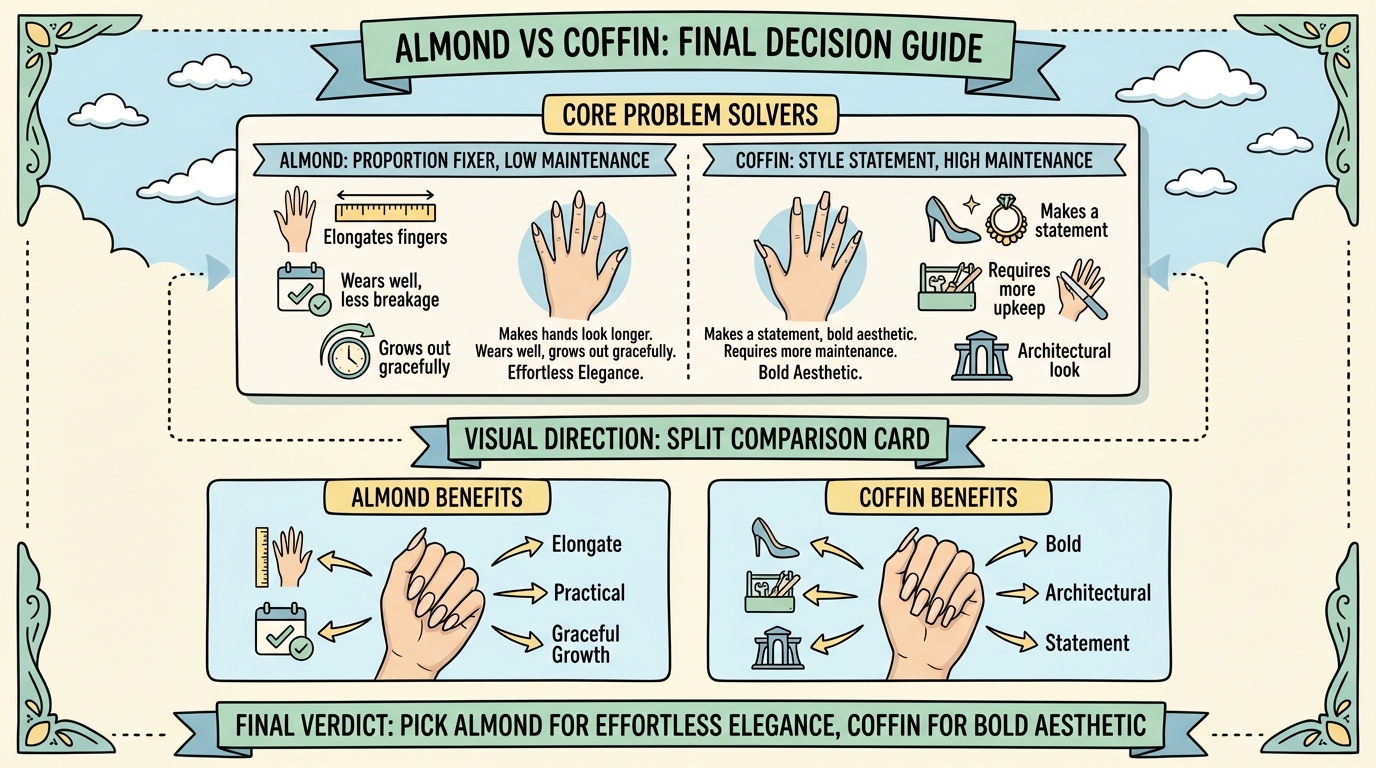
Almond and coffin aren't competitors. They're solutions to different problems.
Almond solves proportion problems. It makes hands look longer, fingers look slimmer, nail beds look narrower. It wears well, grows out gracefully, and stays out of your way during daily life.
Coffin solves style problems. It makes a statement, adds visual weight, creates that architectural silhouette people notice. It requires more maintenance and more awareness, but the aesthetic payoff is real.
Pick almond if you want your hands to look better without anyone knowing why. Pick coffin if you want your nails to be part of your look, not just a background detail.
Or alternate between them. Try almond for three months. Switch to coffin for summer. Go back to almond for fall. Your nails aren't a permanent decision. They're an accessory you get to change.
The only wrong choice is picking a shape because someone on Instagram looks good wearing it. Her hands aren't your hands. Her life isn't your life.
Look at your own fingers. Be honest about what you see. Then pick the shape that fixes what you want fixed and enhances what you want enhanced.
That's what nail techs do. That's what you should do too.